- Have any questions?
- info@shradhakanwar.com

The University Beyond the Degree: From “Knowing” to “Becoming”
Technology should make us curiouser and curiouser….
March 18, 2026From Information Overload to Intentional Intelligence
March 18, 2026The University Beyond the Degree: From “Knowing” to “Becoming”
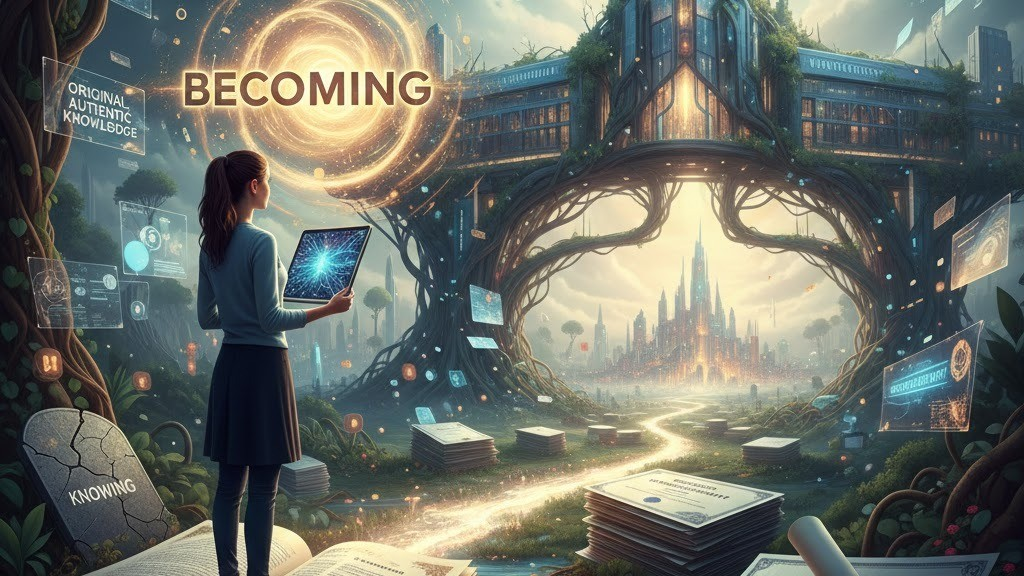
The true essence of a university isn’t found in the transfer of information—it’s in the ontological shift of the student. In an AI-driven ecosystem, the goal is moving from merely “to know” to “to become.”
As original, authentic knowledge becomes the new currency, we are forced to question the very purpose of education. Is a degree a finish line, or just a certificate of a transformation that has only begun?
Here are few curated reads exploring this intersection of market reality and educational evolution:
The Market Reset (Context)
The current market landscape represents a fundamental transition from speculative AI hype to a disciplined “Transformation Economy,” where the once-unified growth of Big Tech is fracturing. As the Financial Times highlights, the “Magnificent Seven” are no longer moving in lockstep, signaling a “tech wreck” that forces investors to distinguish between mere AI adjacency and actual unit economic value. This shift is mirrored in the McKinsey 2025 Global AI Survey and BCG’s research, which indicate that the era of experimental pilots has ended; market leadership now belongs to those who treat AI not as a plug-and-play tool, but as a catalyst for structural and cultural evolution led directly from the real world.
- FT: “Tech wreck signals a market reset” Tech wreck signals a market reset (Katie Martin, Feb 2026)
- Financial Times: “Chart of the Week: A diverging Magnificent Seven” A diverging Magnificent Seven (Hakyung Kim, Feb 2026)
- McKinsey: 2025 Global AI Survey (The ROI Reality)2025 Global AI Survey: Agents & Innovation
- BCG: AI implementation research (The cultural gap) As AI Investments Surge, CEOs Take the Lead
The University’s New Mandate (The Evolution)
By 2026, the university’s mandate has evolved from a warehouse of information to a laboratory for ontological transformation, where the goal is no longer just “knowing,” but “becoming.” As highlighted by Forbes and Campus Tech, this shift is underpinned by a transition from isolated AI pilots to a unified “AI Infrastructure,” where AI Fluency—the ability to ethically and critically navigate agentic systems—is the new graduation standard. UMich and Faculty Focus emphasize that this technological saturation actually heightens the need for “Human-Centeredness,” protecting the space for rigor, curiosity, and high-order reasoning while AI handles administrative and content delivery tasks. Ultimately, reports from ApplyBoard and ETS Insights suggest that in this volatile landscape, the degree is being rebuilt around Outcomes of Agency; its value is no longer in the credential itself, but in the evidence of a learner’s ability to adapt, solve complex problems, and maintain their human differentiator in a world of automated information.
- Forbes: “7 AI Decisions That Will Define Higher Education In 2026” — why the focus is shifting from integrity to AI Fluency. 7 AI Decisions Defining Higher Ed in 2026
- Medium (Ed Madison): “Four Ways AI Reshapes Education” — asking the vital question: What is this learner becoming? Four Ways AI Reshapes Education
- UMich Record: “Human-Centered AI as a Necessity” — a call for rigor, curiosity, and integrity as the core of the “becoming” process. Human-Centered AI as a Necessity
- ETS Insights: “7 Trends Reshaping Higher Ed” — how institutions are pivoting from graduation rates to outcomes of agency.7 Trends Reshaping Higher Ed
- Faculty Focus: “Designing the 2026 Classroom” — moving AI from a pilot project to a catalyst for human impact. Designing the 2026 Classroom
- ApplyBoard 2026 Report: Redefining the student as a discerning agent in a volatile global landscape. Student as a discerning agent
- Campus Tech: “2026 Predictions” — AI as the invisible infrastructure supporting deep, personalized transformation. 2026 Predictions
The degree of the future isn’t a piece of paper; it’s the proof of a human being who can navigate, question, and create in a world where “information” is a commodity, but wisdom is rare.
#FutureOfEducation #HigherEd2026 #AIEducation #OntologicalShift #LifelongLearning #EdTech
